Thursday, 31 May 2012

When Is A National Flag Too Big?


(A health warning to my reader JRB - this post may be bad for you.)

Alyn Smith, an SNP member of the European Parliament, has complained to Seb Coe, the wunderkind chairman of the London 2012 organising committee, about the ban on the Saltire being flown over Scotland's national stadium during the Olympic games.

Under Olympic rules, Scottish athletes represent Great Britain, meaning only the Union flag should be officially flown at venues.

The rule hit the headlines during the Salt Lake City Winter Olympics Games in 2002 when skier, Alain Baxter from Aviemore, was ordered to cover up a blue and white Saltire he had dyed into his hair before competing.

Terms and conditions on tickets for the 2012 Games state there should be no flags of countries that are not participating.

The rule means that the Saltire can't fly over Hampden a spokesman for the organising committee confirmed. "Common sense would be applied for fans, as long as there was no 'political statement' linked to the flag or emblem" they said.

Another response from the committee is 'that people have always been allowed to bring in flags and wave them provided they are not too big or on poles'.

I see two problems with the organising committee's responses.  Firstly, what is its definition of 'common sense'?  It's certainly very different to mine.

Secondly, I've searched in vain to find the definition of 'too big'.  I have a couple of Saltires which I use for a variety of purposes. Both are 5ft by 3ft - a handy size for anything from a table covering to flying from a flagpole.  But would one be too big for the Olympic flag-checking mafia?  Who knows.

If anyone attending a Game's event wants to take along their emblem to show national pride, forget a flag and consider a windsock. If money is no object how about a Saltire mohair throw to keep your shoulders warm?

I would suggest that anyone taking either of these items also remembers to carry the invoice with them just in case the flag-checking mafia don't know the difference between a saltire, a windsock and a throw. It's all down to common sense isn't it?

source

Wednesday, 30 May 2012

Is The Scottish Government Losing The Plot?


Last Friday I didn't see the launch of the Yes Scotland campaign but did view it on the Parliament channel on Sunday. It was less than inspiring and left me wondering to whom it was directed.  Certainly it held little for the average voter and the critics who remarked upon expats who have done well elsewhere leading the event had a point.

The choice of venue was strange too. Maybe for those in attendance it was atmospheric, but on television it seemed sterile and over choreographed, taking the appearance of the performers being ushered from the depths of a black box to the glare of a spotlight intended to highlight their presence.  Colourful it was not and somehow conviction was lost in the production.

Alex Salmond seemed weary and not his usual boisterous self and this perhaps was responsible for the lack of pomp - because there is no doubt the independence referendum will be a historic occasion, regardless of the result.

But recently, apart from thinking Alex Salmond may be tired, I have wondered if he's losing interest in the general governance of Scotland and concentrating his time on changing social values. As yet I can find no figures for the cost of the 'same-sex marriage' consultation but such public consultations don't come cheap.

Now, after the Scottish government has recently agreed a 50p increase in a unit of alcohol on the back of a report from one university, we have the NHS spending £100,000 for the reprint a booklet about pregnancy because one person complained the use of the word dad was discriminating against same-sex couples.  Officials decided to replace 'dad' with 'partner' so now the word dad is being phased out of official use.

A spokesman for NHS Scotland innocently displayed the misuse of money within the NHS:


It is standard practice to review publications on a yearly basis, if not more often. At the time this complaint was received the Ready Steady Baby text had just been through its annual review, changes made and the new edition was printed in December 2011.
‘The review process identified the need to use language that was more inclusive, particularly in relation to same-sex partnerships.’


If 90,000 copies of the Ready Steady Baby booklet cost £100,000 to reprint, how many other NHS booklets are reprinted annually or even less and at what cost?

One hundred thousand pounds could keep several centres for the elderly open, could provide much needed additional psychologists for our mental health services or provide quality vocational training for enthusiastic 14+ year olds - just a few suggestions for better use of a large sum of money.

Why is Alex Salmond so intent upon re-engineering miniscule aspects of society when he should be channelling his energies towards increasing the economy and providing the public with his vision of an independent Scotland, complete with truthful financial projections?

While the UK government slides into absurdity, I would like to think Scotland was in safe hands. Is that wishful thinking?

source

Tuesday, 29 May 2012

NUTS And Regions - Guest Post


A guest post from Edward Spalton

This is the framework within which Mr. Salmond is selling an entirely illusory "independence" - on a par with Slovakia which had come into line with the ESM within a few days of voting to stay out.

Of course, Sir Peter Housden was John Prescott's right hand man for the EU regional project in England so his present role is entirely congruent with the EU's long term aims for which he was Prescott's accomplice.

I have corresponded with Sonya Porter for quite a long time but not met her. She writes some interesting articles.

NUTS and Regions

S Jay Porter

The plan by the European Union to destroy the historical borders -- both internal and external -- of its separate countries is speeding up.
In 1994 we, in the UK, voted in our Counties at the European Elections for the last time.  If you lived in Cornwall, for instance, you sent an MEP from Cornwall to sit in the European Parliament.  But by the next EU election in 1999 as far as the European Union is concerned, the counties had been superseded and the country split into twelve Regions.  The Provinces of Scotland, Wales and Northern Ireland were considered by the EU to be countries and therefore were established as one Region each, but England instead of being one country was now nine Regions.  This meant that if you lived in Newcastle you now lived and voted in the North East Region of the UK, not England.

This was the start of the NUTS  --  Nomenclature of Territorial Units for Statistics (nomenclature dunites territoriales statistiques), or the division of all EU countries into areas ostensibly for statistical purposes.  The basic countries have a two letter code  --  UK, for instance  --  and each Region is an NUTS1 and has an additional letter.  If you live in the South East Region, then you reside in UKJ, while those living in Wales, Scotland and Northern Ireland reside in UKL, UKM and UKN respectively.

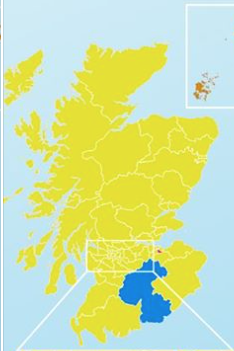
Then comes the first subdivision of the Regions, or NUTS2.  While Northern Ireland remains one NUTS2, Wales now has two and Scotland, which believed it could be an independent country within the European Union, now consists of four NUTS2 subdivisions.  The nine regions of what was England now consist of 30 NUTS2.  There is yet one more sub-division:  NUTS3.  These consist of five groups of districts in Northern Ireland, 23 Groups of unitary authorities or LECs in Scotland, 12 groups of Unitary  Authorities or groups of districts in the nine regions of England.

All these sub-divisions and sub-subdivisions are numbered.  So this means that if you once lived in the Isle of Anglesey, you now live in region UK11 of the European Union or if you once lived in the Shetlands, you now live in UKM66 of the European Union.

Of course the United Kingdom is not the only country to be divided in this way and there are now approximately 264 Regions (NUTS1) covering all the countries which make up the European Union.  To take one instance, currently there are 13 such Regions in Greece.  Their personnel are appointed by the Greek government and the duties of each Region is a miniature of the duties of the central government.  In 2008 the current Greek government announced its plans (as per EU directives) to reduce the number of Regions from 13 to five,  the number of prefectures from 52 to 16 and the number of municipalities from 1050 to 350.  In the meantime came the financial crisis and these plans were shelved but not abandoned.

In addition, there are approximately 110 organisations known as
Euroregions or inter-regions which cross national borders and belong to the Association of European Border Regions.  These are said to be for cross-border co-operation in various fields including the promotion of trade links, cultural ties, transport policies, tourism, education and spatial development.  However, the term Euroregion does not always clearly show the differences in aims and objectives, if they exist at all, compared with other trans-frontier structures which are given different names such as Euregios, Border Regions or Working Communities.  Many of the newly established Euroregions in the central and eastern European countries seem to be in fact, simply communities of interest which are forums for informal trans-frontier information and consultation.  Moreover, the legal frameworks within which the Euroregions operate exhibit such a wide variety of forms that it is difficult to clearly associate one particular legal framework with the term Euroregion.

The first inter-region, called Euregio which took in parts of Germany and the Netherlands, was created by Germany in 1958 to ensure, it stated, that national borders should not be a barrier to the integration of Europe.  Although several of these date back to the1960s, it was the 1990s which saw the largest increase in cross-border regions all over Europe.  In fact today there are virtually no local or regional authorities in border areas which are not somehow involved in inter-regional co-operation initiatives.

Nor do these inter-regions stop at the borders of the current European Union.

Turkey, which has yet to be formally accepted as a member of the EU, nevertheless has extensive inter-regional programmes linking it with Greece.  Switzerland with its substantial banking sector and Norway with its huge resources of oil, are both particular targets in spite of the fact that they, too, are currently outside the EU.  For instance, the Nordic Council, which comprises Norway, Sweden, Finland and Denmark, gets EU grants for all of its eight Euroregions and the EU says that it is necessary to include Switzerland so as to integrate it into European regional planning.  According to the August 2009 Current Concerns, the English edition of the Swiss magazine Zeit-Fragen, largely unknown to the Swiss population (and certainly not voted for by them), this most democratic of countries is being split into three huge Metropolitan Areas  --  Zurich, Geneva and Basel -- ready to act as European Motors and to play leading roles in Europe in a number of respects such as economic performance, decision-making, etc.

But of particular interest to us here in Britain is the fact that
three of these Euroregions cross our borders:  the Arc Manche, the Atlantic Region and the North Sea Region.

The Arc Manche was originally set up in 1966.  It currently includes the French areas of Brittany, Nord-pas de Calais, Lower Normandy, Upper Normandy and Picardy together with the English counties of Dorset, Hampshire, the Isle of Wight, Kent, and West and East Sussex. It has created its own forums for conferences, etc. and on 12th October 2005, members of Arc Manche met in Brighton to create the Channel Arc Manche Assembly.  Inter-regional Assemblies, where they exist, usually consist of regional heads of governments, commissions of executive officers, general secretariats and standing commissions on a wide range of issues. These officials are not elected by the general public. 
At the first meeting of the Arc Manche Assembly, Alain Le Vern from the Upper Normandy region, was appointed President and Brad Watson, from the West Sussex County Council, was appointed Vice President. 

The North Sea Region was created in 2007 and links areas of six countries bordering the North Sea: Norway (which is outside of the EU), Sweden, Denmark, Germany, Belgium, and the Netherlands and the whole eastern side of the UK.

The Atlantic Region, which was possibly created in 2008, takes in the west of Scotland, Wales, Cornwall and Devon, Northern Ireland and Eire, plus parts of south-western France, Spain and Portugal.

There seems to be no information yet about Assemblies for the North Sea or Atlantic Euroregions but it is certain that none of the three will be based in the United Kingdom.  The Arc Manche Region will be run from France, the Atlantic Region from Portugal and the North Sea Region from Denmark.  All three now have legal status and receive large grants from the central funds of the EU (which, of course, includes British taxpayers money).  Between 2007 and 2013, the Arc Manche Region will receive an annual budget of £261 million, the Atlantic Region £127 million and the North Sea Region £219 million.
In other words, the EU is busy knitting the various nations so tightly together, destroying both local and national loyalty, that it will be difficult to unpick them and retrieve our countries should we ever wish to leave the European Union. 

And that's the idea.

PLEASE NOTE:
Although I have done my best to make sure that the above is correct, the information about EU organizations can be very confusing – there are frequent changes of names, areas, competences, etc. – which I take to be a deliberate ploy on the part of the EU in to prevent the general public from gaining information about it.  I apologise to the EU if this is not so.

Monday, 28 May 2012

The War Rages On


I always feel terribly sad when posting the picture of a member of the armed forces who has been killed in the line of duty, because I know the photograph was picked by the soldier prior to deployment.

Above is Captain Stephen Healey, 29, from the 1st Battalion, The Royal Welsh, who was killed on Saturday when the vehicle in which he was travelling was blown up by a bomb in Afghanistan.  He was originally from Cardiff and was commanding the Combined Force Burma reconnaissance platoon.

Capt Healey's death brings the number of British Service personnel killed in Afghanistan to 415.

No words can express my anger at this continual, unnecessary loss of life.

Sunday, 27 May 2012

A Little Sunday Fun


A Short Term Memory Test

You'll be shown 12 photos in the first part and another 12 photos in the second part.

Then, in the third part, you'll be shown 48 photos and asked if you saw them in the first part, the second part, or never saw them at all.

When you've finished the third part your results will be given to you.

Begin here and surprise yourself!  Oh, I fared much better than I expected. After the first part I did take a 5 minute break but didn't after completing the second part. No idea if that helped or hindered.
Related Posts with Thumbnails